

A lot’s happened in the last few months.
Next year I’ll be working with Bellingcat to build a public LLM tool for open source researchers. The tool will use retrieval-augmented generation on an AI model with access to a database of OSINT tools–as well as documentation for the available resources–to reduce friction in tool selection and usage.
I’m also going to be collaborating with Mediastorm to test out AI tooling, simplifying access to and insights from their incredible archive of visual storytelling.
As an ardent admirer of both, it’s a bit surreal to be working with childhood heroes.
I’ll be sharing more behind-the-scenes on current projects in the coming issues, but for now let’s dive in.
Scoutpost.ai
I’ll be opening a private beta to 50 journalists late January. If you’re interested please reply to this email.
After the beta I’ll be open-sourcing a self-contained version of Scoutpost by March, for any newsroom to set up locally and adjust to their own requirements.
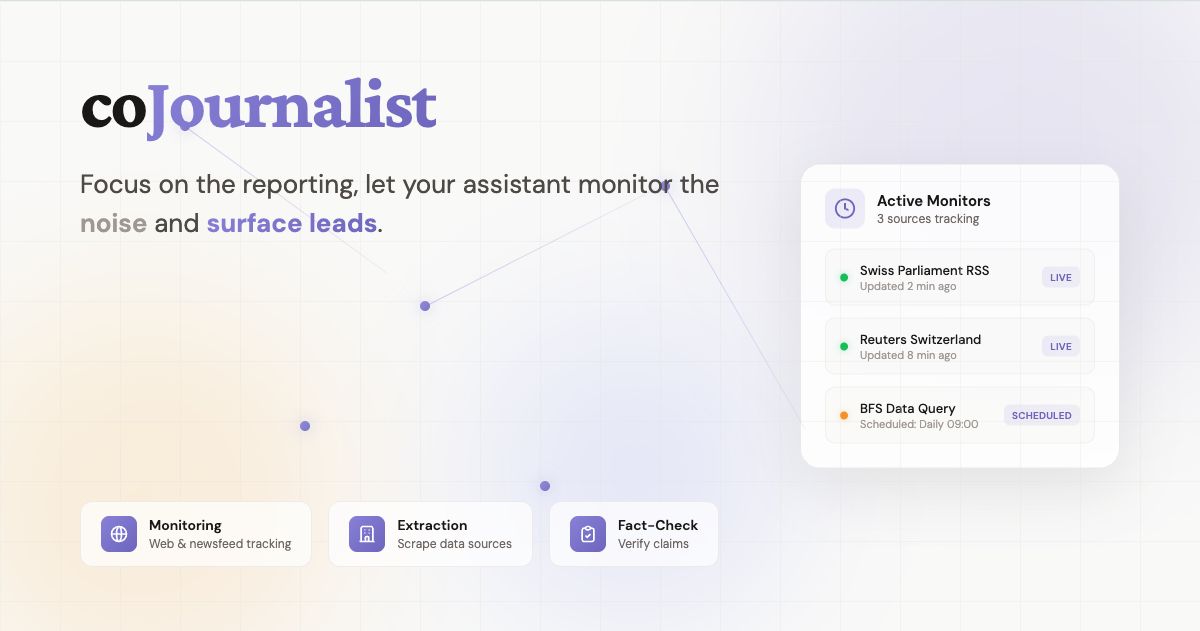
Independent journalists will be able to use a web version which will have free and paid tiers (with different scraping limits). I’m setting up localised scouting systems with web scraping, data querying and newsfeed monitoring–the collected units of information will be used to generate digests for the journalist or to compose articles.
Any profits after running costs and maintenance will be reinvested into investigative journalism grants, as collaborations for the channel.
The newsroom in 2030
We’re living through Schumpeterian creative destruction. The current times require strategy, risk, failing and learning. I’m seeing a lot of scattered, small experiments from large media companies trying to replicate what the rest of the industry is doing, but on a smaller scale. Many are clinging to vanishing processes, albeit with AI, or making tech/UX decisions from an editorial perspective, rather than from the people we intend to inform.
How and where will information be sought? Personalized–but in which formats? How do we build trust and authenticity sustainably, when opinions are polarized and mistakes can happen?
I’m uncertain where journalism is headed or what the newsroom will look like in 2030, but these are the challenges I want to work on, building the future with journalists willing to experiment, creating open-source tools others can use and remix.
For anyone trying to make sense of the products that are being built for our industry, I highly recommend downloading this short paper, it’s a fantastic summary providing crucial visibility.
Buried Signals
Currently collaborating with The New Humanitarian on an investigation. We're testing a new partnership model for independent creators and investigative media to work together.
The collab secures financing for both parties while making investigations more accessible, visible, and impactful - I'm bullish about this being an avenue for investigative journalists moving forward.
I’m also collaborating with Unchartered Territories on a new video for the channel, coming soon!
Visuals
Last month I released Infoviz.design. The answers aren’t perfect (yet) but I’m already using it to source inspiration on projects.
My favorite visual stories lately have been from NZZ. 🔥
This first story starts with a point layer on a map, on scroll the points are transformed and animate into a bar chart. Still wrapping my head around it.
This second story was a collaboration with a Ukrainian data journalism unit, using illustration and cross-border partnership to push an important story.
Reporter’s toolbox
The ever-changing list of things that are worth looking into:
- IDI Follow the Money OSINT toolkit
- Parsing PDFs with Antigravity – Matt Waite’s Collection of Miscellany
- The many AI publishing tools that are emerging: tollbit, gist.ai, prorata
- Google Pinpoint now has an Extract Structured Data function, which is like pdfplumber on steroids. Using a visual interface paired with AI rather than Python to extract data from complex PDFs.
- The Nieman Lab predictions are out, Florent Daudens clustered them by topic
- Using Grok AI for OSINT
- New OSINT AI platforms are blowing my mind: Tesari, Intrace
- I’m excited about the application of AI models for reality capture, extraction and generation for spatial journalism: SAM 3D, ML-Sharp and SAM Audio
- I’ve tested 3D model generation in Polycam, Krea, Rodin and Meshy. The winner is Meshy!
Thank you for reading Nuanced. This post is public, feel free to share it!