
Hello again,
Mycroft 2.0 is an investigator harness to use all of the systems and tools I've built with models that run on your own computer. To make this happen I partnered with Osaurus, an open-source app for running your agents locally, I'm really grateful to their team for making this happen.
Indicator Lab members can install it today, and a self-paced course for them follows at the end of November.
I'm also releasing a large investigation in a couple weeks, months of work with Craig from Indicator and many more journalists, so stay tuned!
The stack
Mycroft
Mycroft keeps your sensitive cases on-device, with Windows and OSX support. Ask it a question and it will:
- search a wiki of your notes on your device
- pull figures from documents and images with a small extraction model
- tell you what your Scoutpost monitors found on the pages and profiles you track
- plan with OSINT Navigator, the Lab's directory of OSINT tools
- file findings into your wiki through the Analyst, a pilot agent that waits for your confirmation
Your wiki lives in OpenKnowledge, an open-source markdown editor whose team is also a Lab partner.
Spotlight 2.0
Spotlight 2.0 is out, with a new orchestration system and a totally new crew of agents.
As a recap Spotlight is an agent system to run investigations. One agent used to do all the research, so early clues slipped out of its memory. Now when you give it a lead it will:
- send a swarm of research agents down the different directions of your plan
- triage what they bring back with a small decision model, so you pick which clues to pursue
- chase those clues with an investigator, while a separate fact-checker tests each finding
- propose what goes into your wiki at the end
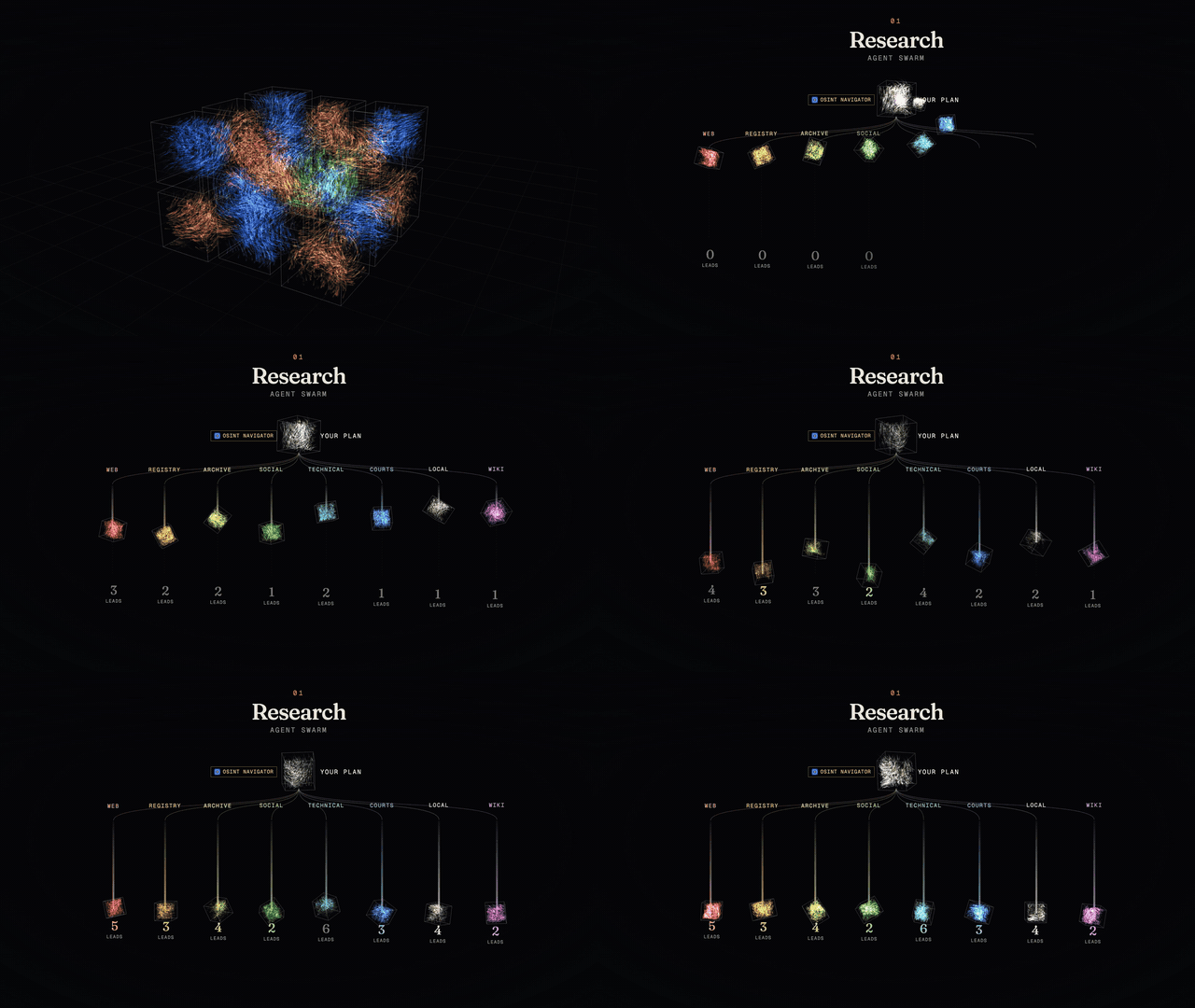
If you want to go into the technical weeds of how the new crew of local agents works together, Going Sovereign is a full visual explainer.
Field notes
DeSmog just published a Spotlight-assisted investigation.
Cécile Marchand and TJ Jordan found that TotalEnergies belongs to at least 32 trade associations that worked to oppose, weaken or delay methane rules in the past two years.

It's the first time somebody has taken the time to publicly credit Spotlight as part of their reporting, for which I'm grateful. Seeing this gave me so much energy, that I've decided to include a catalogue of Spotlight-assisted investigations on the website and promote these stories on my channels.
"The tool is amazing and I anticipate using it for future stories," TJ Jordan
If you've used Spotlight on a story, reply to this email and tell me about it.
|
Sponsored by

This issue is sponsored by MapTiler, the technology provider behind every map in my videos and graphics. I use it for everything from interactive data maps, animating cameras through 3D terrain, reverse geocoding on investigations... It's an incredibly useful piece of technology.
You can start using Splash (open-source) to build your own animated maps.
|
Decoded
Open decision models
Spotlight's triage now runs on an open decision model I trained, Liquid AI's LFM3 release, to sort what the research swarm brings back. It's an incredible model, the training process was simple and rewarding.
Fact-checking models
MiniCheck and FactCG are open models built to check a claim against a source. I tried each one as a second check behind Spotlight's fact-checker. They removed the last false claims that get through the stress test, but MiniCheck also kept 9 of 18 true claims at best and FactCG kept none.
It was a small test of my own, and the numbers are in Going Sovereign.
Poisoned evidence
A paper in the Findings of EMNLP 2026 shows why a fact-checker shouldn't trust everything it retrieves. The authors contaminated 3.1 to 7.4% of a corpus with fluent but false evidence, and fact-checking scores dropped by up to 46.9%. It's one of the papers behind Mycroft's fact-check skill, which counts sources by site.
Worth your time
Tools
🕸️ bl00d.money — an ongoing investigation that says it tracks $150.23B in money flows behind Israel's war campaigns, as a database of 294 entities and 384 sources. This is the kind of structured information that agents will work from to give their humans personalized, valuable, intelligence on global situations.
📡 treg — a pay-per-call registry of data providers, now integrated into Spotlight and Scoutpost to collect public posts from X, Instagram, TikTok, Facebook and LinkedIn.
🏛️ capitol-cli — a free command line tool that tracks U.S. House members' stock trades from their STOCK Act filings.
✈️ Velocity — a self-hosted live map of aircraft, ships and satellites that records what it sees, so you can rewind to any past moment.
🚢 HullCipher — puts each sanctioned ship's listing beside what the ship broadcasts on AIS.
🪪 TrueScreen C2PA Viewer — reads a file's Content Credentials in your browser, with no sign-up and nothing uploaded.
📊 Anomaly — a small plugin I built so your agent can pull records from 41 public sources and run 45 detectors that flag unusual patterns.
🎙️ Hex — local voice dictation for Mac, Windows and Linux, with the world's best landing page if you want a laugh.
🧭 T3 Code — I compared Hermes, OpenBot, Mercury and T3 Code to run my agents from. T3 Code is the best open-source desktop app I've found that doesn't tie you to one model provider, and it works across desktop and phone.
Exit signal
A Superhuman AI Researcher is likely to arrive summer 2027, according to a new forecast from the AI Futures Project. That's an AI good enough for the frontier lab to replace its entire research staff - from then onwards it handles all AI research by itself and we cannot define what happens next.
 Chart by the AI Futures Project.
The authors moved their dates forward after METR, an outside evaluator, estimated that Anthropic is making progress about twice as fast as before. They write that companies are "not on track to align" a system like that. They want frontier development paused or slowed.
METR says Anthropic redacted most of the evidence behind its estimate.
I'm still optimistic about specialized, decentralized AI that runs locally and stays in many hands, but 2027 is way too soon for an existential shift in our reality - not with the current alignment issues being so evident. Next year I'll turn my own tools on the frontier labs, starting with what they spend on lobbying against regulation.
— Tom